

| |
 |
Our offer > Recent achievements
More and more clients are turning to Géoclip |
|
| |
Following
are the most outstanding productions in Web-based interactive
cartography.
One of the strengths of these applications is that they are updated
daily, so that the information put online is always as "fresh"
as possible.
Display a map with the implantation of Géoclip Servers in the world
|
| |
|
|
|
| canton of Basel-Stadt (Switzerland) |
After establishing in French-speaking Switzerland (Geneva, Neuchâtel, Vaud, Jura), Géoclip is reaching over the linguistic barrier and is being adopted by the city of Basel on the site of Kartorama, and soon also in the Canton of Graubünden.
The Géoclip interface is currently available in five languages: French, English, Spanish, German and Dutch, and also soon in Italian. |
 |
| Conseil Général of the Gers department (departmental council) |
G'Observ', the site of the Observatory of the Gers territories, offers a "department dashboard for all economic players in the Gers [...] so they can understand, anticipate and foresee the future of the Gers [...] appreciate its richness, its stakes ... to discover it again".
G'Observ' provides the wide range of tools found in Géoclip Server: assisted access, detailed interactive cartography, automatic tables, graphics, territory portraits, etc. |
 |
Institut National de la Statistique et des Études Économiques (National Institute of Statistics and Economics) |
Initially this tool was only available with login access but now it is open to all. The Local Implantation Diagnostic Tool (ODIL, Outil d'aide au diagnostic d'implantation locale) is designed to help entrepreneurs review statistical data about the area where they wish to setup their business. ODIL creates a report with results relative to potential customers and possible competing businesses within the implantation zone. |
 |
| Chambre Régionale de Commerce et d'Industrie Midi-Pyrénées (Midi-Pyrénées Chamber of Commerce and Industry) |
The OBSéco of Midi-Pyrénées is the observatory of economic activity of the Midi-Pyrénées Chamber of Commerce and Industry and of the 10 CCI.
Its cartography unit is based on the Géoclip Server and lets users explore a statistical database produced by about twenty regional partners.
Subscribers can also get a wider range of data and more advanced functionality. |
 |
| SEM régionale des Pays de la Loire (Regional SEM of the Loire Valley) |
The Loire Valley region opens its Observatoire Régional Economique et Social (Ores - Regional Observatory for the Economy and Social Issues). This website, opened to everyone, offers among other things a regional atlasbased on Géoclip Server. Every themes pertinent to the competence of the region are covered. There are many geographic levels : municipalities, CTU (contract territories), urban aereas...
The objectives of the Observatory are to "Meet the needs of the territories as closely as possible" and "Share knowledge". |
 |
| Services and Payment Agency |
The CartoBenef application lets one know who benefits from European funds. Subsidized projects are numbered by region, by department and by municipality to go from a global to a detailed vision.
This simple use of Géoclip Server lets users see the detailed list of projects that benefit from European funds with a few clicks on a region, department of municipality. |
 |
| Basse-Normandie regional council |
The "Système d'information statistique territorialisé"(territorialized statistical information system) set up by the Basse-Normandie region offers assisted tools to access local statistics via a web browser.
This project gives Géoclip Server a new automatic tabulation tool: an interactive assistant to build a statistical table, defining the geographic units and reference zones in lines and the gross or calculated indicators in columns.
This information system is now open to everyone on the Internet. |
 |
The City of Toulouse |
CartoStats is a "statistical software package that lets users observe the territory from a municipal scale". It gives access to detailed information by neighborhood, output areas or addresses over an urban map or aerial photo. At first it will only be available to city employees, then slowly opened to partners, then to the public at large.
The steps of the project are described in detail in this report. |
 |
Environmental observation and statistics (General Commission for Durable Development - Ministry of Ecology) |
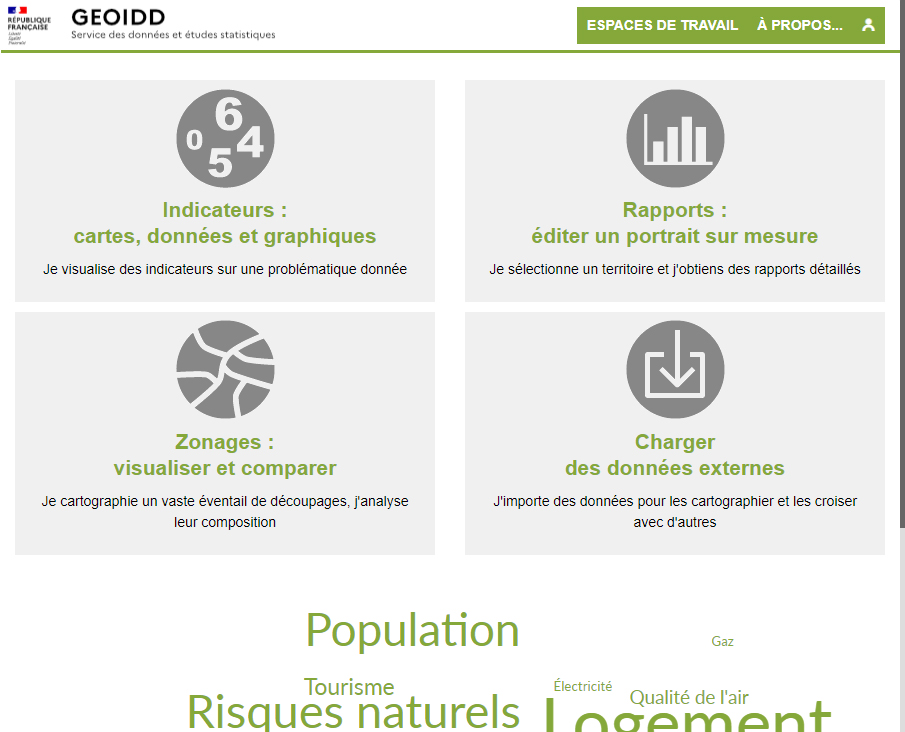
Géoïdd is an interactive cartography tool that lets users view the cartography of information related to durable development in France and some of its territories. Géoïdd displays two types of views:
- statistical indicators, with the statistical visualization tool,
- geographical data, with the geographical visualization tool.
In parallel, the Coast Observatory (Observatoire du littoral) has updated its interactive cartography tool specific to the French coastal territory with Coastal Géoïdd. |
 |
| State and canton of Vaud (Switzerland) |
The canton research and statistical information service (SCRIS) opened an internet site to the public that lets them display statistical data over a cartographical support. It is freely accessible at www.scris.vd.ch/cartostat and this new interactive production is particularly user-friendly, even playful. It was developed for a wide audience yet remains a powerful tool for analysis and publication. »
You can read the entire press release of Statistique Vaud |
 |
Urcam Ile-de-France
(Regional conglomerate of private doctors in the Ile-de-France area) |
The "Soigner-en-Ile-de-France" site maps out medical offering that shows where private doctors are located according to specialty (total number by gender et age median) as well as the distribution in health care facilities according to their type of activity, and this for all the municipalities and all medical areas of the region. |
 |
| Regional Health Observatory PACA |
The SirséPaca web site publishes in-depth information on health available to all, but particularly geared towards health professionals of the Provence Alpes Côte d'Azur region.
Several applications of the Géoclip Server are published to tackle a different theme, such as health status, pathologies, and therapy offers. They are presented on different geographical levels, municipalities, departments, or health territories. |
 |
| Government of Canada’s Rural Secretariat |
"The Community Information Database is an evolving tool designed to provide rural Canadians with easily accessible economic, demographic, and social data at the community level. "
After a first iteration that dates back more than four years, Canada’s Rural Secretariat has updated its site www.cid-bdc.ca. This new version integrates the newest Géoclip Server functionalities, such as territorial portraits and WMS (Web Map Service). |
 |
| University of Lausanne |
The Geographical Institute of the University of Lausanne (IGUL) has integrated the Géoclip Server into its palette of webmapping tools. A first for Romania: An interactive atlas of the country.
“Interactive cartography, offered around a selection of indicators on the scale of Romania municipalities, encourages a wider gathering of information on the territories."
Géoclip is also used in teaching situations with students. |
 |
République et canton de Neuchâtel
(Switzerland) |
An interactive statistical mapping application has just opened on the site of the Statistical Office of the canton of Neuchatel:
"The statistical mapping is a new application for everyone to analyze statistical data in the form of an interactive atlas. These are hundreds of thematic maps that can be made and combined in many areas. The atlas will also serve to analyze the temporal evolution of indicators, in the form of maps, charts or graphs." |

see press release of the statistical office
of the canton of Neuchatel |
| Ministry in charge of Youth and Sports |
The Carto Stats applications are proposed to all agents, on a national level as well as in local divisions. They make the cartographic tools accessible to a wider audience than just a limited number of specialists.
The central administrator manages a common database about the whole of France including overseas territories.
Each regional administrator is free to manage the data concerning his/her own territory. |
 |
| |
|
|
| |
|
 |
|